
September 27, 2025
From a Southland paddock to a world-first solution
Hear from Southland farmer and inventor Grant Lightfoot on how Kiwi-EcoNet came to life from a hand-stitched prototype to a world-first solution tackling plastic waste and protecting livestock.
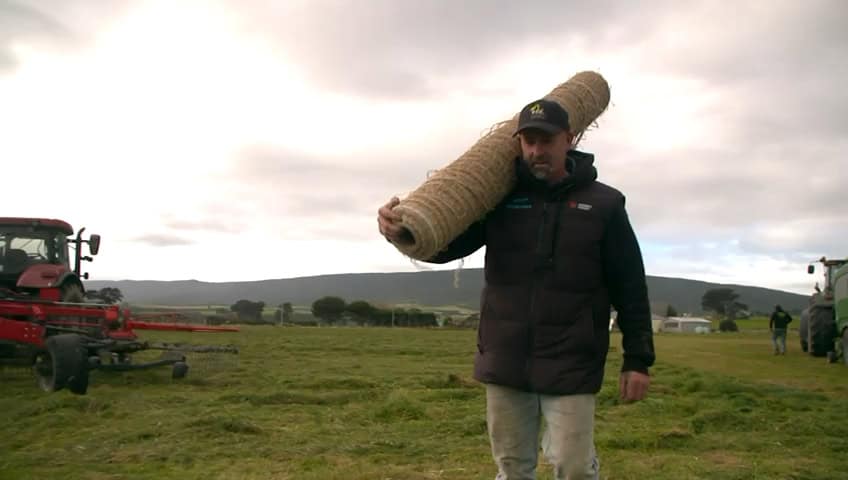
Click to play
In Orepuki, a tiny Southland settlement in New Zealand with fewer than 100 people, local farmer Grant Lightfoot noticed a deadly problem hiding in plain sight. The plastic netting used to wrap bales - strong, cheap, and everywhere - was killing stock. Cows, horses, and sheep were swallowing stray strands, which tangled into blockages the size of basketballs. The result was slow, painful deaths and an ever-growing pile of plastic waste on farms.
Grant decided there had to be a better way.
An idea born in the deep
Grant didn't dream up his solution in a lab or office - but in a decompression chamber, while working as a commercial diver on oil rigs. After 27 years offshore, he wanted more time at home and a project with purpose. That spark became Kiwi-EcoNet: a natural, edible net wrap designed to replace plastic.
A "labour of love"
The first prototypes were stitched by hand. Grant and his partner Colleen spent eight months tying a double half-hitch knot over and over, producing just 50 metres of net. "Colleen did most of it," Grant laughs. "I'd get bored."
The first material they tried was hemp - but traces of THC ruled out exports to places like the US. The breakthrough came with jute, a tough, bamboo-like fibre that stock can safely eat. Jute gave the net both the strength to hold a bale and the digestibility to make plastic redundant.
From scepticism to success
"People laughed at me at first," Grant admits. And funding it himself nearly broke him. But the first baler trial changed everything: the jute net ran cleanly through standard equipment, holding the bale tight and feeding out without a scrap of plastic.
That moment confirmed Kiwi-EcoNet could work on any farm, anywhere.
Interest from around the world
From that tiny workshop in Orepuki, enquiries have rolled in from as far as Iceland and Chile. Partners in India - the global home of jute - are lining up factories to scale production. Manufacturing offshore is the only viable way to keep it affordable for farmers.
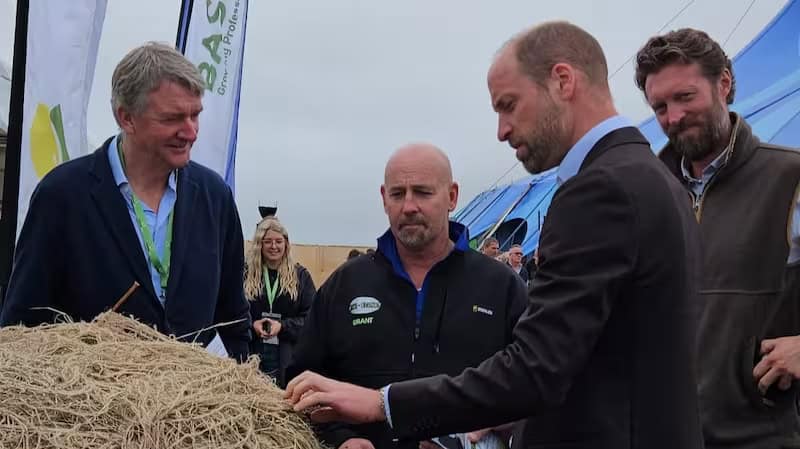
And the story has travelled further than anyone expected. At the UK's Groundswell regenerative farming festival, Grant found himself pitching to Prince William, who stopped to hear about the edible bale net. The encounter was short and down-to-earth - "just another guy," Grant recalls - but it sparked even more attention, including interest from Jeremy Clarkson's Diddly Squat Farm.
Why it matters on your farm
- No plastic to strip – Feed out faster, with less hassle.
- Livestock safe & edible – Stock can safely eat the net with the bale.
- Runs on your gear – Works with standard balers.
- Better for the land – Cuts plastic waste and disposal costs.
Driven by purpose
For Grant, this isn't just about inventing a product. It's about protecting animals, reducing waste, and giving farmers a practical alternative that fits the way they already work.
"Seeing it come out of the baler, or watching people's faces when they see it - it gives me goosebumps,” he says. “That makes all the years of hard work worth it."
Footnote
As a result of Grant showing Prince William Kiwi-EcoNet, he subsequently received a letter from King Charles expressing his interest in using Kiwi-EcoNet on his estates.
Here’s a photo of Grant with the letter from Buckingham Palace.